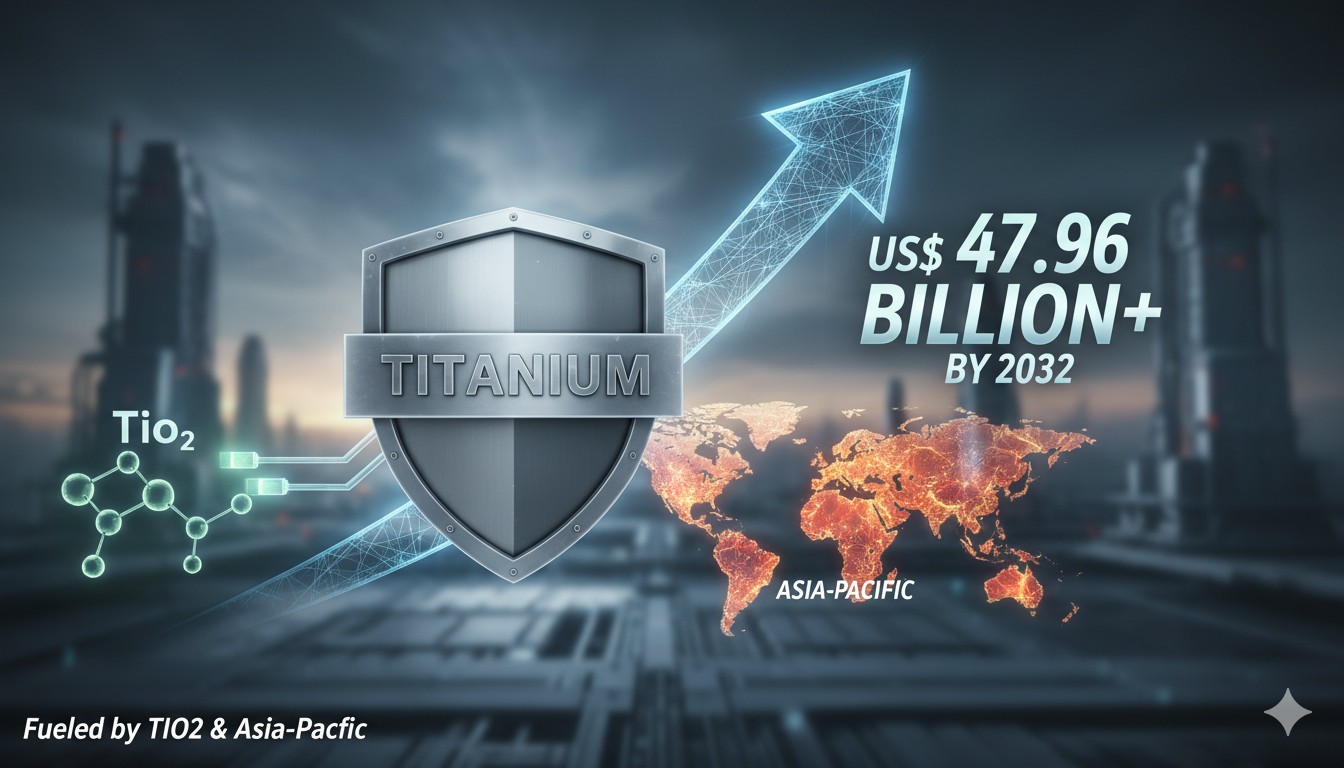
The global titanium market, valued at approximately $29.64 billion in 2024, is poised for steady expansion at a compound annual growth rate of around 6.2% through 2032, ultimately surpassing $47.96 billion. This trajectory is primarily propelled by robust demand for titanium dioxide in pigments and coatings, alongside surging consumption in high-performance sectors such as aerospace and automotive. Asia-Pacific emerges as the dominant regional force, fueled by rapid industrialization, infrastructure projects, and manufacturing growth in key economies like China and India.
Titanium Market Surges Toward $47.96 Billion Milestone by 2032
The titanium industry continues to demonstrate resilience and upward momentum, driven by its unique combination of properties including exceptional strength-to-weight ratio, superior corrosion resistance, and biocompatibility. As industries worldwide prioritize lightweight, durable, and high-performance materials, titanium’s applications span from everyday consumer products to critical infrastructure and advanced engineering.
Titanium dioxide (TiO₂) remains the cornerstone of the market, commanding the largest share due to its unparalleled opacity, brightness, and UV protection. This compound finds extensive use in paints and coatings, where it provides essential whiteness and durability for architectural, automotive, and industrial finishes. The paints and coatings sector alone absorbs a substantial portion of global TiO₂ output, as demand rises for eco-friendly, long-lasting exterior and interior products amid ongoing urbanization and renovation trends. Plastics and rubber applications follow closely, with TiO₂ enhancing product aesthetics, weather resistance, and longevity in packaging, consumer goods, and automotive components. Paper production also contributes meaningfully, utilizing TiO₂ for improved print quality and brightness in high-end publications and packaging materials.
While TiO₂ dominates volume and value in the broader titanium landscape, titanium metal and its alloys represent the higher-value, faster-growing segment in specialized domains. Aerospace and defense lead titanium metal consumption, where the material’s ability to withstand extreme temperatures and stresses makes it indispensable for airframes, engine components, landing gear, and structural elements in commercial and military aircraft. As global air travel rebounds and new-generation aircraft programs advance, including more fuel-efficient designs that incorporate greater titanium content to reduce weight and emissions, this segment sustains strong momentum. Automotive applications are expanding as well, particularly in electric vehicles and high-performance models, where titanium components help optimize range, handling, and durability without compromising safety.
Medical and healthcare sectors increasingly rely on titanium for implants, prosthetics, surgical instruments, and dental applications, benefiting from its biocompatibility and resistance to bodily fluids. The chemical processing industry uses titanium equipment for handling corrosive substances, while energy and power generation, including desalination plants and renewable infrastructure, leverage its longevity in harsh environments.
Asia-Pacific stands out as the primary engine of market growth, accounting for the largest regional share and the highest growth trajectory. Rapid urbanization, massive infrastructure investments, and expanding manufacturing bases in China, India, and Southeast Asian nations drive unprecedented demand for TiO₂ in construction-related paints, coatings, and plastics. China’s position as a leading producer and consumer of titanium feedstock further solidifies the region’s dominance, supported by integrated supply chains and cost-competitive production. India’s booming automotive and construction sectors, combined with government initiatives for housing and infrastructure, add substantial volume. Japan contributes through advanced aerospace and electronics applications, while emerging markets across the region accelerate adoption in consumer and industrial goods.
North America maintains a significant presence, anchored by a mature aerospace industry and strong defense spending that prioritizes titanium in next-generation platforms. Europe focuses on sustainable applications, with emphasis on automotive lightweighting and green coatings formulations that align with stringent environmental standards.
Key growth drivers include:
Escalating infrastructure and construction activity worldwide, particularly in emerging economies, boosting TiO₂ consumption in protective and decorative coatings.
Aerospace sector recovery and expansion, with rising aircraft production rates and incorporation of titanium in composite-heavy designs.
Automotive shift toward electrification and performance enhancement, favoring lightweight titanium alloys for chassis, exhaust systems, and battery components.
Advancements in production technologies, such as improved extraction and processing methods, helping moderate costs and expand supply availability.
Heightened focus on sustainability, where titanium’s recyclability and long service life support circular economy principles in multiple industries.
Challenges persist, including raw material price volatility for ilmenite and rutile ores, energy-intensive processing requirements, and regulatory pressures on mining and chemical production. Supply chain disruptions from geopolitical factors occasionally impact feedstock availability, though ongoing investments in diversified sourcing and recycling mitigate these risks.
The outlook remains positive, with titanium positioned to benefit from megatrends in urbanization, mobility transformation, and advanced manufacturing. As demand patterns evolve toward higher-performance and sustainable solutions, the market’s trajectory toward exceeding $47.96 billion by 2032 appears well-supported by fundamental industry dynamics.
Disclaimer: This is a news and market analysis report based on industry trends and projections. It does not constitute financial, investment, or professional advice.