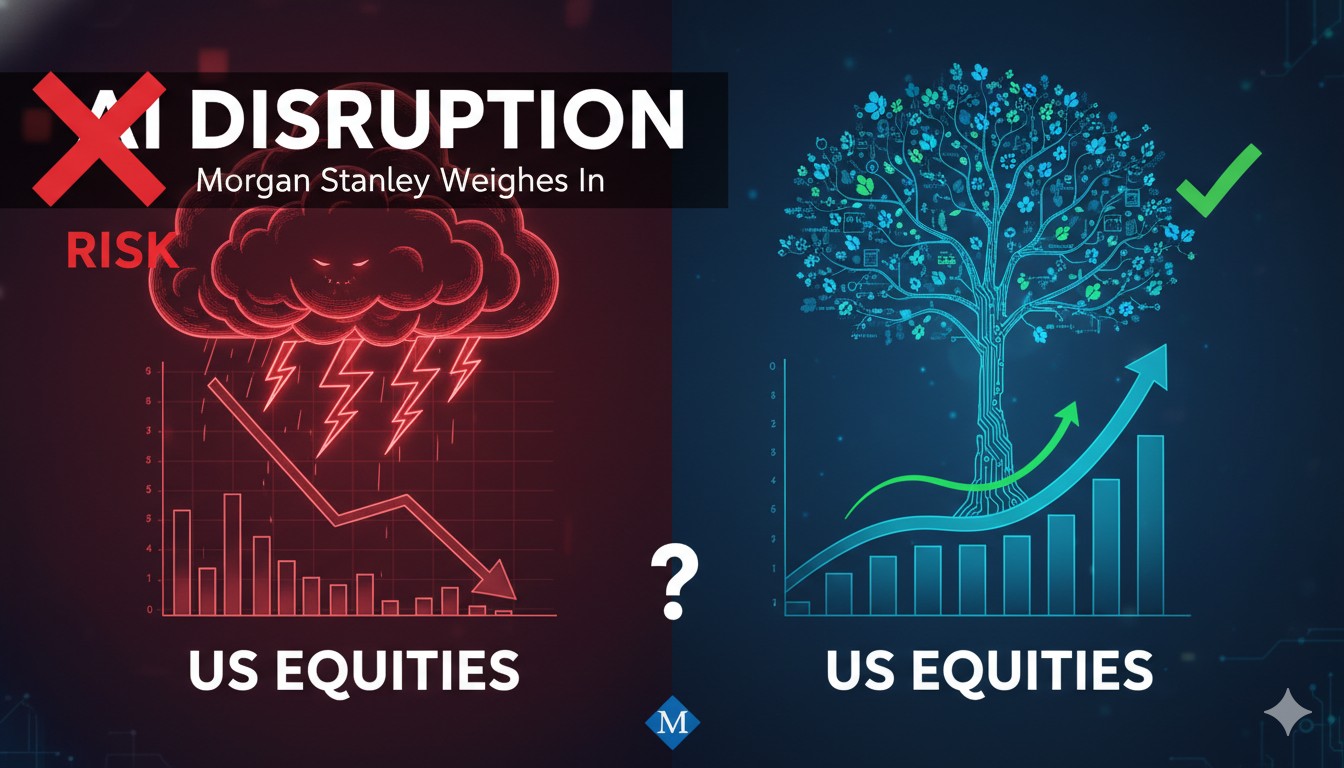
“Recent market volatility driven by fears of AI disruption is presenting attractive buying opportunities for investors. While concerns focus on potential job losses and sector upheaval, only about 13% of the S&P 500 market cap faces significant vulnerability. These at-risk areas are trading at historically cheap valuations, remain under-owned by investors, and often exhibit strong pricing power alongside high concentrations of AI adoption. The broader narrative points to accelerating AI integration across industries, where incumbents and adopters stand to gain from enhanced productivity and efficiency gains, outweighing the limited disruptive threats.”
Detailed Analysis: Balancing AI Disruption Risks with Adoption Opportunities in US Equities
Morgan Stanley’s latest insights highlight a nuanced view on artificial intelligence’s role in reshaping the US equity landscape. Recent market swings, characterized by sharp selloffs in certain sectors amid headlines about AI agents and rapid technological advances, have sparked widespread investor anxiety. Strategists argue that this fear-driven pricing action is overdone in many cases and is creating selective entry points for those focused on quality and positioning.
A key metric from the analysis underscores the contained nature of true disruption risk: vulnerable segments represent just 13% of the S&P 500’s total market capitalization. This limited exposure suggests that broad-based panic selling has disproportionately punished stocks that are not fundamentally threatened. These at-risk areas are not only a small slice of the index but also sit at attractive valuations relative to historical norms. Investor positioning in these groups is notably light, falling into the 20th percentile of net exposure levels observed since 2010. Paradoxically, many of these same companies demonstrate robust AI adopter traits and maintain solid pricing power, positioning them to benefit from the technology rather than succumb to it.
The strategists emphasize a shift in focus from AI “builders”—primarily infrastructure providers and hyperscalers that have dominated gains—to “adopters” and well-entrenched incumbents. Companies effectively integrating AI tools to boost productivity, streamline operations, and enhance margins are seeing their investment cases strengthen amid the current environment. This rotation dynamic is gaining traction as evidence mounts that AI deployment is accelerating faster than anticipated in many sectors.
Software and services firms have borne much of the recent brunt, with shares pulling back sharply on worries about AI-generated code, automation of routine tasks, and potential obsolescence of traditional models. However, the view is that these concerns are exaggerated for high-quality names. Fundamentals remain solid, with revenue trajectories holding up and earnings revisions trending positively in resilient pockets. The market appears to be pricing in worst-case replacement scenarios that are unlikely to fully materialize in the near term, especially given the collaborative potential between existing platforms and emerging AI capabilities.
Broader market leadership is also evolving. Mega-cap technology has shouldered much of the AI narrative to date, but signs point to a broadening out as productivity benefits diffuse beyond the core enablers. This could support equal-weighted indices catching up and reduce concentration risks. While CapEx intensity tied to AI infrastructure remains a headwind for some valuations, the long-term payoff from efficiency gains is expected to drive durable returns.
Risks persist and warrant monitoring. Accelerated adoption could pressure labor markets more quickly than expected, potentially eroding pricing power if efficiencies spread rapidly and commoditize certain services. CapEx cycles could face abrupt shifts if returns disappoint, and volatility may linger as investors demand clearer proof of monetization from massive spending. Yet the baseline outlook leans constructive: AI is viewed more as a transformative force enhancing corporate performance than a blanket destroyer of value.
In sectors like banking, professional services, and select industrials, AI emerges as a net positive, augmenting human capabilities, accelerating processes, and opening new revenue streams without fully displacing incumbents. High-barrier physical assets and “HALO” trades—those resistant to technological obsolescence—offer hedges for those still wary.
Overall, the current dislocation favors stock pickers who differentiate between hype-driven selloffs and genuine structural shifts. Opportunities lie in high-quality AI adopters exhibiting pricing resilience and growth momentum, while the narrow band of pure disruption exposure limits systemic downside. This environment underscores a classic market pattern: fear creates mispricings that reward disciplined analysis and selective positioning in US equities.
Disclaimer: This article is for informational purposes only and does not constitute investment advice, a recommendation, or an offer to buy or sell securities. Investors should conduct their own research and consult with qualified professionals before making decisions. Market conditions can change rapidly, and past performance is not indicative of future results.