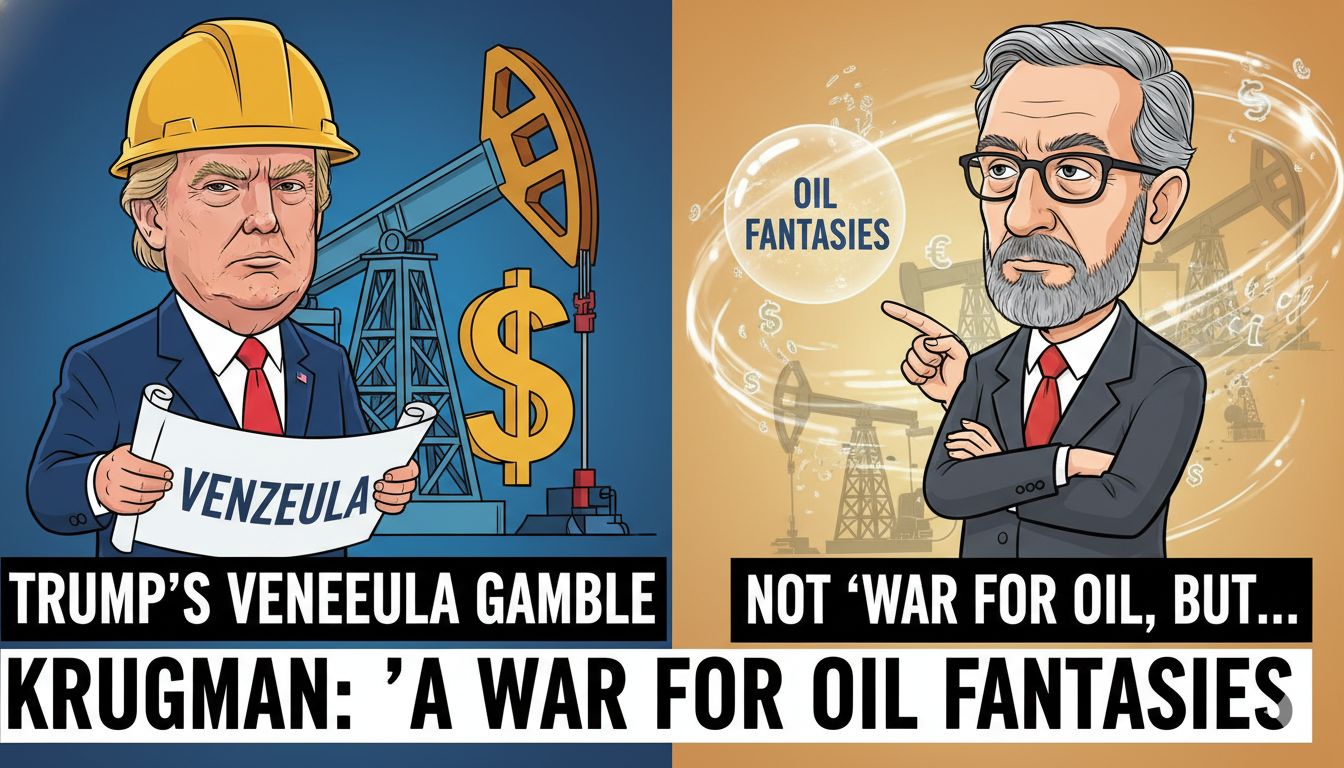
“Economist Paul Krugman critiques President Trump’s Venezuela strategy as driven by illusions of vast oil wealth, highlighting the impracticalities of extracting heavy crude amid crumbling infrastructure, while current low oil prices and global market shifts undermine any potential gains.”
President Trump’s bold move into Venezuela has ignited fierce debate in financial circles, with Nobel-winning economist Paul Krugman labeling it less a strategic grab for petroleum resources and more a pursuit of outdated delusions about easy riches. As the U.S. assumes temporary oversight of the South American nation’s operations following military strikes and the capture of former leader Nicolás Maduro, Krugman argues that the promised economic windfall is largely fictional, rooted in misconceptions about the true value and extractability of Venezuela’s reserves.
Venezuela boasts the world’s largest proven oil reserves on paper, estimated at over 300 billion barrels, but the bulk consists of extra-heavy crude from the Orinoco Belt. This type of oil requires intensive processing to become marketable, involving high costs for dilution, upgrading, and transportation—expenses that have ballooned due to years of neglect under previous regimes. Current production hovers at approximately 800,000 barrels per day, a fraction of its peak in the late 1990s when output exceeded 3 million barrels daily. Restoring capacity could demand upwards of $180 billion in investments over a decade, according to energy analysts, with no quick returns in sight given the global push toward renewables and electric vehicles.
Economic Realities Behind the Rhetoric
Trump’s administration has emphasized revitalizing Venezuela’s oil sector through U.S. expertise, suggesting American firms could step in to “fix” the dilapidated infrastructure and unlock “tremendous” value. However, Krugman points out that this vision ignores fundamental market dynamics. Global oil supply remains ample, with major producers like Saudi Arabia and Russia capable of ramping up output to counter any Venezuelan resurgence. The heavy nature of Venezuelan crude means it trades at a steep discount—often $10 to $20 per barrel below lighter benchmarks—further eroding profitability.
Recent market data underscores these challenges:
| Metric | Value (as of January 9, 2026) | Year-over-Year Change |
|---|---|---|
| Brent Crude Price | $62.12 per barrel | -22.11% |
| WTI Crude Price | $58.10 per barrel | -19.45% (estimated) |
| Venezuela Production | ~800,000 bpd | +5% from 2025 low |
| Global Oil Demand Growth | 1.2 million bpd (projected) | Slowing due to EVs |
These figures reflect a broader downturn in fossil fuel valuations, exacerbated by geopolitical tensions and the accelerating energy transition. U.S. shale producers, already efficient at lower price points, could face increased competition if Venezuelan oil floods the market, potentially depressing domestic prices and hurting American energy stocks.
Geopolitical and Financial Risks
From a finance perspective, Trump’s gamble carries substantial downside for U.S. investors and taxpayers. The policy envisions U.S.-led reconstruction of refineries, pipelines, and export terminals, but security concerns loom large—kidnappings, sabotage, and local resistance could deter private sector involvement. Major oil companies have historically shied away from high-risk environments without ironclad guarantees, and the current administration’s approach risks entangling federal funds in what Krugman deems a “fantasy” pursuit.
Moreover, the strategy could ripple through international markets. Allies in Europe and Asia, wary of perceived resource imperialism, might impose trade barriers or pivot to alternative suppliers. For U.S. consumers, any short-term dip in gasoline prices from increased supply might be offset by long-term inflationary pressures if reconstruction costs balloon or if global alliances fray.
Key Points on Potential Outcomes
Short-Term Boost Illusion : Initial U.S. intervention might stabilize output at 1-1.5 million bpd within 2-3 years, but profits would largely flow to specialized refiners capable of handling heavy crude, not broadly to the U.S. economy.
Investment Hurdles : Billions in capital are needed, yet low oil prices (Brent under $65) make ROI timelines stretch to 10+ years, deterring venture capital and favoring state-backed entities.
Market Volatility : The U.S. Oil Fund has declined 3.53% in the past week amid uncertainty, signaling investor skepticism.
Broader Implications : This move tests Trump’s “America First” energy dominance, but critics like Krugman warn it diverts focus from domestic innovation in clean tech, where U.S. firms lead globally.
As Wall Street digests these developments, the consensus leans toward caution—Venezuela’s oil may symbolize power, but its economic promise remains mired in complexity and cost.
Disclaimer: This article is for informational purposes only and does not constitute financial advice, investment recommendations, or endorsements. All data and opinions are based on publicly available information and should not be relied upon for making decisions.