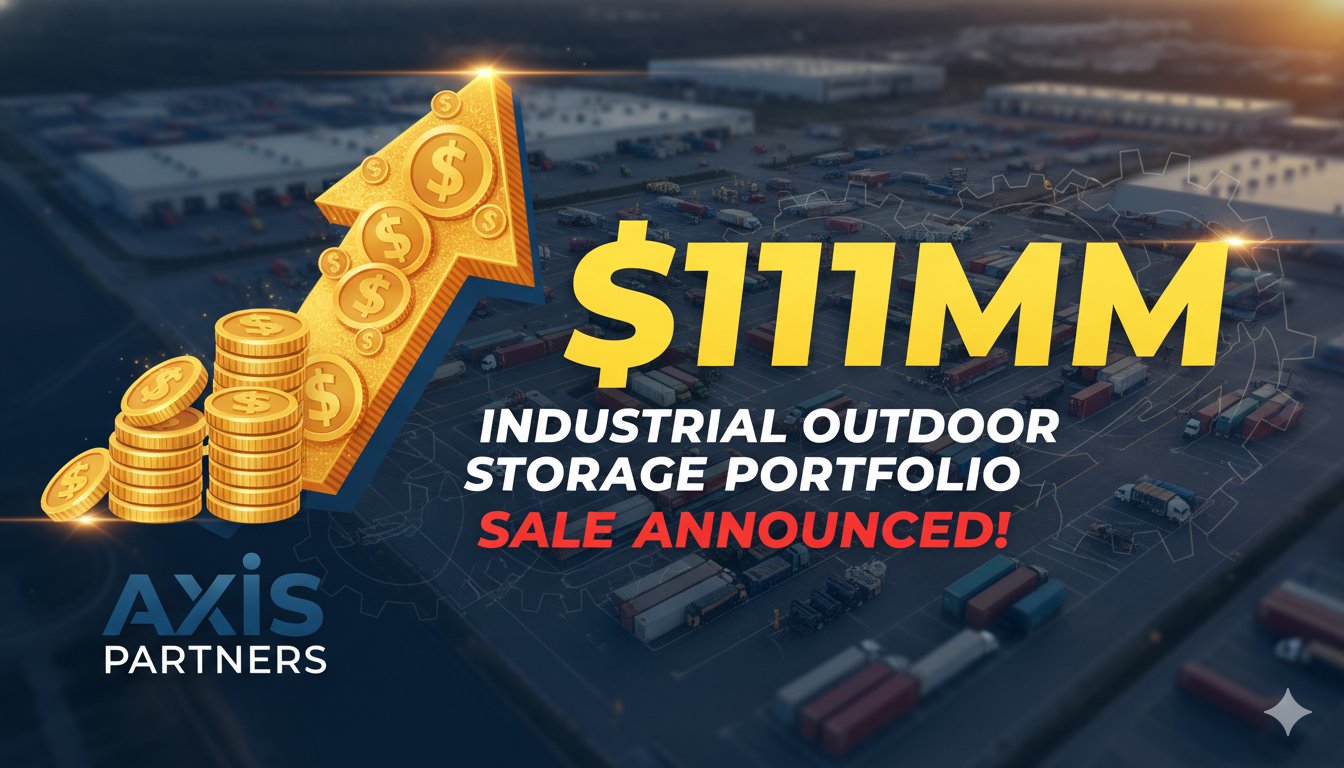
Axis Partners, in collaboration with Sweetwater Holdings, has finalized the $111 million sale of an 85-acre portfolio featuring 22 renovated industrial outdoor storage facilities to Realterm, with assets concentrated in high-growth Sunbelt markets like Atlanta and Texas; this transaction underscores the resilience and investor appeal of the IOS sector amid surging demand from logistics and e-commerce, where rents have climbed over 100% since 2020 and market valuations exceed $200 billion.
The sale encompasses a diverse array of properties tailored to meet the evolving needs of supply chain operations, reflecting a strategic pivot toward institutional-grade assets in a sector that’s outpacing traditional warehouse performance. The portfolio, meticulously curated over the past two years, includes facilities optimized for maintenance operations, fleet management, bulk material handling, equipment leasing, trucking hubs, and conventional industrial spaces. These improvements have positioned the assets as premium options in infill locations, where proximity to major transportation networks drives operational efficiency.
Realterm, a prominent player in transportation-oriented real estate, emerges as the buyer, aligning with its focus on enhancing logistics infrastructure. The deal was facilitated by a specialized brokerage team, ensuring a seamless transition that highlights the portfolio’s appeal in a market where industrial outdoor storage vacancies hover below 5% nationally, fueled by constrained supply and robust tenant demand.
Portfolio Breakdown and Market Positioning
The 85-acre collection spans key economic hubs, with a heavy emphasis on regions benefiting from population influxes, manufacturing resurgence, and trade expansions. Asset allocation reveals a calculated spread across dynamic metros, capitalizing on local economic drivers such as port activity in coastal areas and manufacturing booms in inland centers.
| Location | Percentage of Portfolio | Key Economic Drivers |
|---|---|---|
| Atlanta | 38% | Logistics hub with major airport and interstate access; e-commerce fulfillment growth |
| Texas (various metros) | 31% | Energy sector integration, border trade, and manufacturing onshoring |
| Norfolk | 6% | Port-centric operations supporting international shipping |
| Columbus | 6% | Central distribution advantages for Midwest-Southeast corridors |
| Los Angeles | 5% | Pacific import gateway with high-density urban logistics |
| Nashville | 4% | Automotive and healthcare supply chain expansions |
| Jacksonville | 4% | Southeast port activity and intermodal connectivity |
| Other Southeast markets | 6% | Emerging industrial nodes with lower entry barriers |
This distribution leverages the Sunbelt’s advantages, including favorable zoning, lower operational costs, and proximity to growing consumer bases. In Atlanta, for instance, the assets tap into a market where industrial absorption rates have exceeded 10 million square feet annually, driven by retailers optimizing last-mile delivery. Texas holdings benefit from cross-border freight surges, with trailer storage demand up 15% year-over-year amid trade policy stabilizations.
Tenant Diversity and Operational Enhancements
A hallmark of the portfolio is its tenant mix, drawing from national conglomerates, regional specialists, and local enterprises across industries like construction, transportation, and retail support. This diversification mitigates risk, with lease structures emphasizing long-term commitments that align with the sector’s low turnover rates—typically under 10% annually. Tenants utilize the spaces for mission-critical functions, such as staging areas for electric vehicle fleets and secure yards for heavy machinery, adapting to trends like sustainability mandates where EV-ready infrastructure is increasingly standard.
Under Axis’s management, the properties underwent targeted upgrades, including enhanced security systems, improved paving for heavy-load tolerance, and utility expansions to support modern logistics tech. These investments not only boosted functionality but also elevated property values in a market where IOS rents have surged 123% since 2020, far surpassing bulk warehouse gains. Nationally, the IOS segment commands premiums due to its role as a vital supply chain link, with properties near ports and rails fetching cap rates as low as 4.5% for prime assets.
Sector-Wide Implications and Growth Trajectory
This transaction arrives amid a broader IOS boom, where the asset class has transitioned from niche to essential, attracting billions in institutional capital. Market projections peg the U.S. IOS valuation at $228 billion in 2025, climbing to $367 billion by 2033 at a 6.1% compound annual growth rate. Drivers include e-commerce’s relentless push for faster fulfillment—online sales now represent 15% of total retail—and onshoring initiatives that demand more domestic storage nodes.
In the Sunbelt, industrial deals have accelerated, with sales volumes reaching $68 billion in 2025 alone, split between high-quality assets commanding stable cap rates and secondary ones facing adjustments. The region’s appeal lies in its demographic shifts, with migration fueling workforce availability and consumer demand. However, challenges like zoning restrictions and potential overbuilding in select submarkets warrant careful navigation, as investors apply stricter due diligence to ensure resilience against economic fluctuations.
Strategic Outlook for Investors
For those eyeing IOS opportunities, this sale exemplifies the rewards of thematic investing: identifying undervalued parcels in logistics corridors and scaling them to institutional standards. Axis’s approach—combining macro trends like supply chain reconfiguration with micro-level canvassing—has yielded a portfolio that not only delivers strong yields but also positions for future expansions, such as integrating AI-driven inventory management or green tech retrofits.
Comparable deals in the Sunbelt underscore the momentum, with recent transactions in Texas and Florida highlighting buyer preferences for diversified, infill properties. As interest rates stabilize, expect more capital inflows, potentially compressing cap rates further for top-tier IOS assets while rewarding operators who prioritize operational efficiencies.
Evolving Market Dynamics
Looking ahead, the IOS landscape is maturing, with tech integrations like drone surveillance and automated gating becoming commonplace to meet tenant needs. Sustainability features, including solar installations and permeable surfaces for stormwater management, are gaining traction, aligning with corporate ESG goals. In high-demand areas, redevelopment of underutilized land into IOS sites offers untapped potential, though entitlement hurdles can extend timelines.
The sector’s outperformance stems from its scarcity: unlike traditional warehouses, IOS requires specific land attributes—flat, secure, and accessible—that limit new supply. This imbalance supports ongoing rent escalation, projected at 6-8% annually through 2030, making it a hedge against inflation in portfolios.
Disclaimer: This news report is for informational purposes only and does not constitute financial advice or endorsement of any investment strategies. Sources are not mentioned.