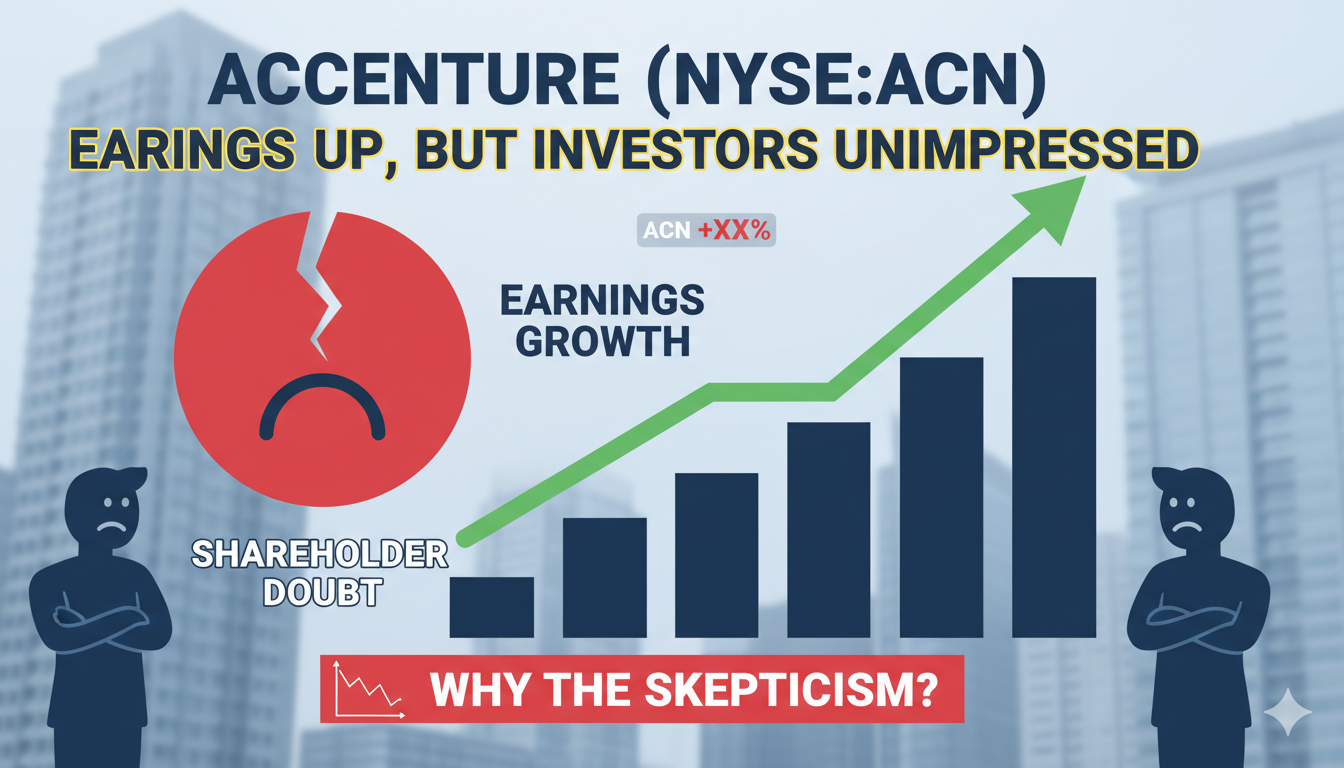
“Accenture reported robust earnings growth in its latest quarter, with revenue climbing 6% year-over-year to $18.74 billion and adjusted EPS rising to $3.94, beating expectations. However, the stock has plummeted 32% over the past year, reflecting investor concerns over near-term guidance, economic uncertainties, and challenges in federal contracts. Analysts forecast 7.86% EPS growth ahead, but elevated short interest signals ongoing pessimism.”
Financial Performance
Accenture’s fiscal first quarter of 2026 showcased steady expansion across its core segments, underscoring the company’s resilience in a volatile global economy. Revenue reached $18.74 billion, marking a 6% increase from the prior year, driven primarily by demand for digital transformation services, generative AI integrations, and cloud migrations. This growth was achieved despite headwinds in certain geographies, where currency fluctuations trimmed reported figures by about 1%. In local currency terms, the uptick was even stronger at 5%, aligning with the upper end of management’s prior projections.
Adjusted earnings per share came in at $3.94, surpassing analyst consensus of $3.73 by a notable margin. This beat stemmed from efficient cost management, with adjusted operating margins holding firm at 17%, even as the company ramped up investments in talent and acquisitions. GAAP EPS stood at $3.69, reflecting one-time adjustments for restructuring costs related to workforce optimization. Net income for the quarter totaled $2.34 billion, up 4% year-over-year, bolstered by a favorable tax rate of 22.5%.
Breaking down by business lines, the Communications, Media & Technology segment led with 9% growth, fueled by AI-driven solutions for telecom clients. Health & Public Service followed closely at 7%, though federal contracts faced delays due to policy reviews under new administrative guidelines. Products and Resources segments each grew 5%, with strength in consumer goods and energy transitions. Geographically, North America contributed 48% of revenue with 6% growth, while Europe and Growth Markets added 4% and 8%, respectively.
New bookings hit $19.2 billion, a 7% rise, with a book-to-bill ratio of 1.1x, indicating healthy pipeline visibility. Managed services bookings grew 10%, reflecting long-term client commitments, while consulting bookings increased 4%, tempered by cautious spending in discretionary projects.
Over the full fiscal 2025, which concluded in August 2025, Accenture delivered total revenues of $69.7 billion, a 7% increase in local currency. Adjusted EPS for the year rose 8% to $12.93, while GAAP EPS climbed 6% to $12.15. This performance exceeded initial guidance, thanks to accelerated adoption of AI tools, which generated over $2 billion in related revenues, up 30% from the prior year.
Market Reaction and Shareholder Sentiment
| Key Financial Metrics | Q1 FY2026 | Q1 FY2025 | % Change |
|---|---|---|---|
| Revenue | $18.74B | $17.71B | +6% |
| Adjusted EPS | $3.94 | $3.73 | +5.6% |
| Net Income | $2.34B | $2.25B | +4% |
| Operating Margin (Adj.) | 17% | 17.2% | -0.2% |
| New Bookings | $19.2B | $17.95B | +7% |
Despite these solid results, Accenture’s stock has endured significant pressure. Shares closed at approximately $264, down from a 52-week high of $398, representing a 32% decline over the past 12 months. This underperformance lags the S&P 500’s 15% gain in the same period. In the week following the Q1 earnings release on December 18, 2025, the stock dipped an additional 6.2%, as investors fixated on softer-than-expected forward guidance.
Short interest in the stock has surged 12.55% recently, now covering about 1.5% of the float, a sign of mounting bearish bets. Trading volume spiked to over 5 million shares on earnings day, well above the average of 4 million, with the price initially falling 2.1% in pre-market before recovering modestly to end up 1.5% at $278 intraday.
Investor unease appears rooted in several factors. Near-term revenue guidance for Q2 FY2026 projects $17.68 billion, in line with estimates but signaling a sequential slowdown from Q1’s momentum. Management cited ongoing geopolitical tensions, including supply chain disruptions in Europe and Asia, as potential drags. Additionally, federal business in the U.S. has slowed due to procurement pauses and contract reviews by government agencies, potentially shaving 1-2% off growth in the Health & Public Service segment.
Over a longer horizon, the stock’s three-year return stands at -8.8%, contrasting with a five-year compound annual total return of 13%, which trails the S&P 500’s 16% and the IT sector’s 26%. This divergence highlights a shift in perception: while Accenture was once viewed as a growth darling, current valuations reflect doubts about sustaining double-digit expansion amid intensifying competition from pure-play AI firms and economic softening.
Future Outlook and Growth Drivers
Looking ahead, Accenture’s management has reiterated full-year FY2026 guidance for revenue growth of 5-7% in local currency, with adjusted EPS expected between $13.10 and $13.50, implying 7-10% growth. Analysts largely concur, projecting EPS expansion of 7.86% to $13.73, supported by a forward P/E ratio of 18.89, below the historical average of 25.
Key to this outlook is the company’s AI push. Generative AI bookings exceeded $1.4 billion in Q1, with total AI-related revenues projected to hit $3 billion for the year, a 50% jump. Accenture aims to train 80,000 employees in AI specialties by FY2026’s end, enhancing its edge in large-scale implementations. Acquisitions, totaling $1.2 billion in Q1, have bolstered capabilities in data analytics and cybersecurity, with 15 deals closed across sectors.
However, risks loom. Elevated global uncertainty, including inflation pressures and regulatory scrutiny on tech consulting, could compress margins. The federal segment, comprising 15% of revenue, faces ongoing challenges from policy shifts, with management anticipating a review period extending into mid-2026. Currency headwinds, if the dollar strengthens further, might reduce reported growth by 1-2%.
On the capital allocation front, Accenture remains shareholder-friendly. The quarterly dividend stands at $1.63 per share, yielding 2.47% forward, with a payout ratio of 53.88% leaving room for hikes. Share repurchases totaled $1.5 billion in Q1, part of a $4 billion annual program, contributing to a total shareholder yield of 5.26%.
Analyst Perspectives
| Projected Metrics | FY2026 Estimate | % Change from FY2025 |
|---|---|---|
| Revenue | $73-75B | +5-7% |
| Adjusted EPS | $13.10-13.50 | +7-10% |
| AI Revenues | $3B | +50% |
| Dividend Yield (Fwd) | 2.47% | +4% (from prior) |
Wall Street maintains a moderate buy consensus on Accenture, with an average price target of $298, suggesting 13% upside from current levels. Of 25 analysts, 18 rate it a buy, citing undervaluation at a trailing P/E of 21.81 and PEG ratio of 2.78. Bulls emphasize the firm’s diversified portfolio—spanning consulting (45% of revenue), managed services (55%)—and its moat in enterprise-scale transformations.
Bears, however, point to decelerating EPS growth from 1.2% in the past year, arguing that without a macroeconomic rebound, multiples could contract further. Normalized P/E at 19.85 and EV/EBITDA at 13.3x are seen as fair but not compelling given peers like IBM at 26.51x P/E. Sentiment indicators, including increased short interest, underscore a wait-and-see approach among institutions.
In sector comparisons, Accenture’s price-to-sales ratio of 2.35 lags the IT services average of 3.5, reflecting discounted growth prospects. Yet, with ROE at 26.9% and free cash flow margins at 16.28%, the company outperforms on efficiency metrics.
Disclaimer: This article is for informational purposes only and does not constitute financial advice, investment recommendations, or an endorsement of any securities. Readers should conduct their own research and consult with a qualified financial advisor before making investment decisions. The information presented is based on publicly available data and may contain errors or omissions. Past performance is not indicative of future results.