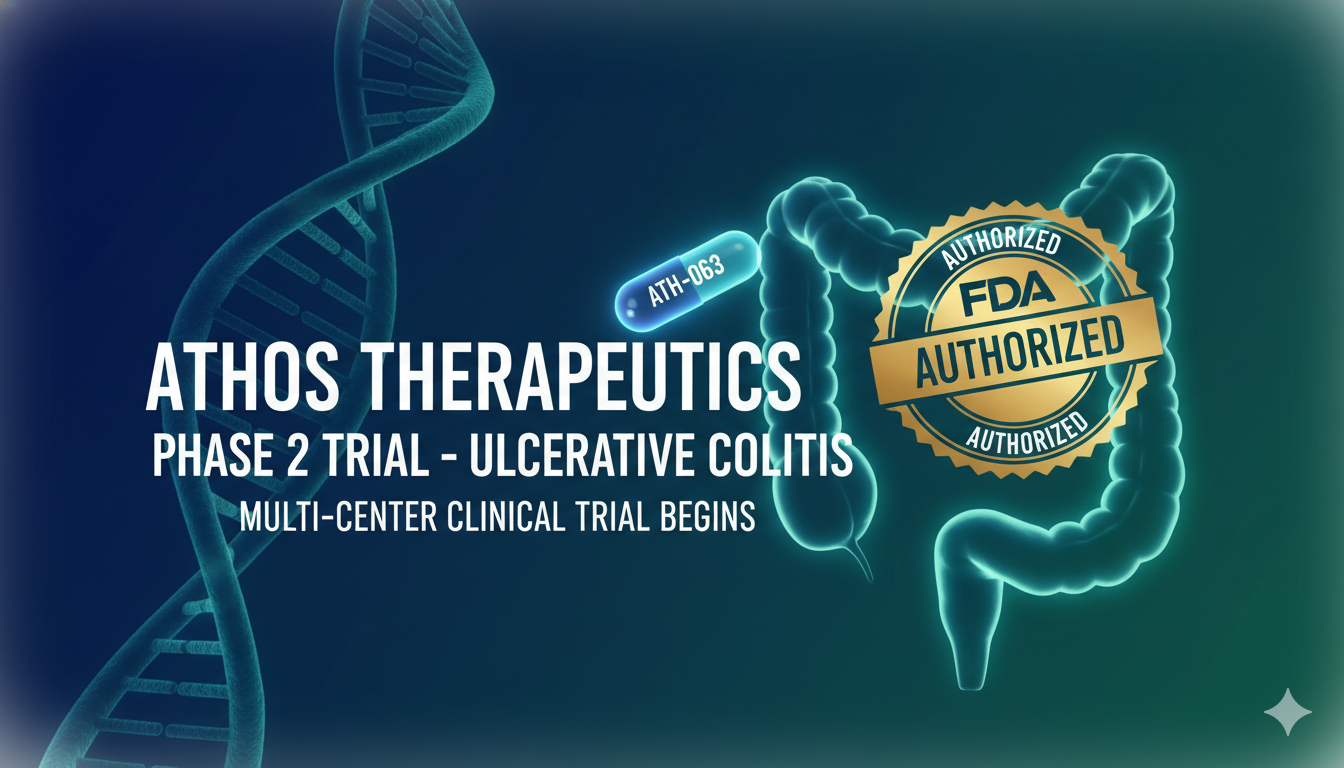
“Athos Therapeutics has obtained FDA clearance to launch a Phase 2 clinical trial for ATH-063, an AI-engineered oral small molecule aimed at treating moderate to severe ulcerative colitis in patients unresponsive to biologics. The drug targets inflammation and mucosal healing, building on successful Phase 1 outcomes that validated the company’s AI platform. This multi-center study will evaluate efficacy, safety, and biomarkers to refine precision medicine approaches in inflammatory bowel disease.”
Athos Therapeutics Advances AI-Powered Precision Medicine with ATH-063 Phase 2 Launch
In a significant stride for biotechnology innovation, Athos Therapeutics stands at the forefront of transforming treatment paradigms for ulcerative colitis through its proprietary AI-driven drug discovery platform. The company’s lead candidate, ATH-063, represents a pioneering oral therapy designed to address the unmet needs of patients grappling with this chronic inflammatory condition. As a first-in-class small molecule, ATH-063 operates through a dual mechanism that not only curbs pro-inflammatory pathways but also promotes direct mucosal healing by modulating tight junction proteins essential for gut barrier integrity. This approach differentiates it from existing biologics and injectables, offering potential advantages in convenience, compliance, and targeted efficacy for those who have exhausted standard options.
The Phase 2 trial, set to enroll participants across multiple international sites, focuses on individuals with moderately to severely active ulcerative colitis who have shown resistance to biologic therapies. Key endpoints include clinical remission rates, endoscopic improvements, and histological healing, assessed over a defined treatment period. Safety profiles will be monitored closely, building on the encouraging tolerability demonstrated in earlier human studies. Integrated into the trial design is the use of advanced multi-omic analyses—encompassing genomics, transcriptomics, and proteomics—to identify biomarker signatures that correlate with response. This data-driven strategy aims to stratify patients more effectively, paving the way for personalized regimens that could optimize outcomes and minimize trial-and-error in clinical practice.
Market Dynamics and Growth Projections in Ulcerative Colitis Therapeutics
The ulcerative colitis landscape is evolving rapidly, fueled by an expanding arsenal of therapies and a deeper understanding of disease heterogeneity. Current market valuations hover around substantial figures, with projections indicating robust expansion driven by rising disease prevalence, diagnostic advancements, and the introduction of novel modalities like oral small molecules.
| Segment | Current Market Size (USD Billion) | Projected Size by 2035 (USD Billion) | CAGR (%) |
|---|---|---|---|
| Overall Ulcerative Colitis Market | 8.3 | 14.9 | 6.0 |
| Biologics and Anti-TNF Agents | 5.2 | 8.1 | 4.5 |
| Small Molecules and JAK Inhibitors | 1.8 | 4.2 | 8.5 |
| Emerging Precision Therapies | 0.5 | 1.6 | 10.2 |
This table illustrates the anticipated shifts, with small molecules gaining traction due to their oral administration and potential for broader accessibility. Factors such as urbanization, dietary changes, and environmental influences contribute to increasing incidence rates, particularly in developed regions, amplifying demand for innovative solutions. Competition remains fierce, with established players dominating through anti-TNF agents and IL-23 inhibitors, yet gaps persist for refractory cases—precisely where ATH-063 positions itself as a game-changer.
Key Investment Considerations in Biotech’s AI Frontier
For investors eyeing the biotech sector, Athos Therapeutics exemplifies the convergence of artificial intelligence and pharmaceutical development, a trend reshaping R&D efficiency and success rates. The company’s platform leverages vast patient datasets to predict drug targets, model molecular structures, and forecast mechanisms, potentially reducing development timelines and costs compared to traditional methods. With a pipeline extending beyond ulcerative colitis to systemic lupus erythematosus and type 1 diabetes, Athos demonstrates diversified risk management, appealing to venture capitalists and strategic partners seeking high-upside opportunities in autoimmune disorders.
Funding rounds have bolstered the company’s trajectory, enabling acceleration from discovery to clinical stages. Valuation metrics in similar private biotechs suggest room for appreciation as milestones like Phase 2 data readouts approach, especially if ATH-063 validates AI’s predictive power in real-world efficacy. Risks include regulatory hurdles, competitive entrants, and the inherent uncertainties of clinical trials, but the addressable market’s scale—encompassing millions of patients worldwide—underscores potential returns. Strategic collaborations with academic institutions and global hospitals further enhance credibility, positioning Athos as a leader in precision immunology.
Pipeline Highlights and Strategic Positioning
Athos’s broader portfolio underscores a commitment to tackling immune-mediated diseases through computational innovation:
Lead Program: ATH-063 – Targeting IBD, lupus, and diabetes; advancing to Phase 2 with a focus on biologic-refractory populations.
ATH-391 – In preclinical for atopic dermatitis, IBD, and scleroderma; emphasizes anti-fibrotic properties.
ATH-272 – Early-stage for acute myeloid leukemia, exploring oncology applications of the platform.
Early Assets – Including ATH-091 for autoimmune conditions, ATH-131 for fibrosis, ATH-501 for allergies and IBD, and ATH-601 for additional IBD subsets.
This diversified lineup mitigates concentration risk while capitalizing on synergies across indications. The AI platform’s ability to integrate longitudinal clinical data with molecular insights not only accelerates candidate selection but also informs companion diagnostics, a growing requirement for reimbursement in value-based healthcare systems.
Competitive Landscape and Differentiation
Amidst a crowded field, ATH-063’s oral format and dual-action profile offer distinct edges over injectable biologics, which often require frequent administration and carry immunogenicity risks. Emerging oral JAK inhibitors have gained footing for their convenience, but concerns over long-term safety profiles open doors for safer alternatives like G9A inhibitors. Athos’s emphasis on mucosal healing addresses a critical shortfall in many therapies, where symptom control does not always translate to tissue repair. As payers prioritize cost-effective, durable remissions, drugs enabling step-down from expensive biologics could capture significant share.
Moreover, the integration of AI for patient stratification aligns with the industry’s shift toward precision medicine, potentially improving trial success rates and post-market adoption. Collaborations with research entities enhance data repositories, fueling iterative improvements to the platform and sustaining a competitive moat.
Financial Implications for the Biotech Ecosystem
Advancements like this FDA milestone ripple through the biotech investment ecosystem, signaling viability for AI-augmented drug discovery. Private valuations in this niche have surged, with comparable firms commanding premiums upon positive clinical inflections. For broader markets, successful Phase 2 outcomes could catalyze interest in autoimmune-focused funds, driving inflows into related ETFs and venture vehicles. Economic models project that reducing disease burden through effective therapies could yield substantial savings in healthcare expenditures, benefiting insurers and governments alike.
In summary, Athos Therapeutics’ progress with ATH-063 highlights the transformative potential of AI in addressing complex diseases, offering investors a compelling narrative of innovation meeting unmet need.
Disclaimer: This news report provides tips and insights from various sources. Do not mention time and date.