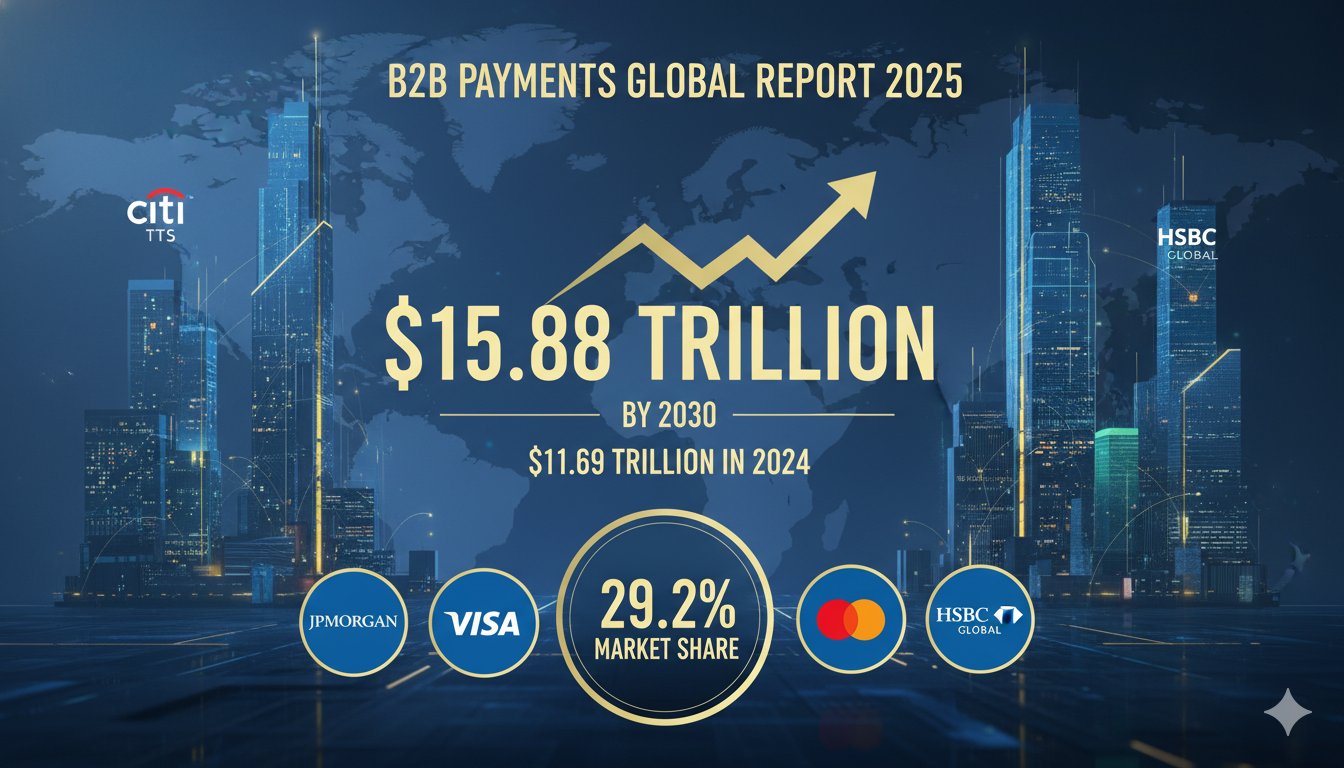
“The global B2B payments landscape is poised for steady expansion, climbing from $11.69 trillion in 2024 to $15.88 trillion by 2030 at a 5.2% CAGR, fueled by digital adoption, cross-border efficiencies, and innovative fintech integrations. Major players like Citi TTS, JP Morgan, HSBC Global, Visa, and Mastercard command a combined 29.2% market share, driving competition amid evolving regulatory and technological shifts.”
Market Overview and Projections The B2B payments sector represents a cornerstone of global commerce, facilitating transactions between businesses that underpin supply chains, procurement, and operational financing. With transaction volumes reflecting the health of international trade, the market’s trajectory highlights resilience despite economic headwinds. Projections indicate a compound annual growth rate of 5.2%, translating to an increase from the current valuation to a robust $15.88 trillion by the end of the decade. This growth is underpinned by rising digitization, where traditional methods like checks and wire transfers are increasingly supplanted by automated, real-time solutions.
Key to this evolution is the integration of embedded finance, allowing seamless payments within enterprise software platforms. Transaction values are expected to rise steadily, with annual increments driven by higher volumes rather than inflationary pricing pressures. For instance, domestic payments continue to dominate, accounting for over 80% of total flows, while cross-border segments grow faster due to globalization and e-commerce expansion.
| Year | Market Size (USD Trillion) | YoY Growth (%) |
|---|---|---|
| 2024 | 11.69 | – |
| 2025 | 12.30 | 5.2 |
| 2026 | 12.94 | 5.2 |
| 2027 | 13.61 | 5.2 |
| 2028 | 14.32 | 5.2 |
| 2029 | 15.05 | 5.1 |
| 2030 | 15.88 | 5.5 |
Growth Drivers Shaping the Landscape Several factors are accelerating the B2B payments market’s momentum. Foremost is the push toward real-time processing, with networks handling billions of transactions annually and setting new standards for speed and transparency. Businesses, particularly small and medium enterprises, benefit from simplified onboarding and reduced costs, lowering barriers to entry in digital ecosystems.
Regulatory mandates, such as e-invoicing requirements in various jurisdictions, are compelling companies to modernize workflows, intertwining compliance with payment efficiency. Additionally, the rise of virtual cards and embedded payment solutions is quadrupling revenue pools in certain segments, as platforms integrate finance directly into operational tools. Fraud prevention and data analytics emerge as differentiators, with advanced AI-driven controls minimizing risks in high-value transfers.
Cross-border commerce amplifies these trends, where currency volatility and tariffs necessitate agile solutions. Innovations in blockchain and stablecoins are beginning to streamline international settlements, reducing intermediary fees and settlement times from days to minutes. Large enterprises lead in adoption, but SMEs contribute significant incremental growth, especially in emerging markets where digital infrastructure is rapidly scaling.
Digital Transformation : Over 70% of B2B transactions are expected to shift to digital rails by 2030, driven by API integrations and cloud-based platforms.
Cost Efficiencies : Average transaction fees could drop by 15-20% through competitive pricing and value-added services like predictive analytics.
Sustainability Focus : Eco-friendly payment options, such as carbon-neutral processing, are gaining traction among environmentally conscious corporations.
Key Players and Competitive Dynamics The market features a blend of established financial giants and agile fintech disruptors. Dominant entities hold substantial sway, with their combined revenue share underscoring a landscape that is competitive yet accessible for specialists. These leaders invest heavily in technology, expanding product suites to include fraud detection, multi-currency support, and integrated treasury management.
Specialized providers target niche areas, such as regional payment gateways or industry-specific solutions for manufacturing and retail. Partnerships are proliferating, with banks collaborating with card networks to offer hybrid models that combine the reliability of traditional systems with the speed of modern fintech.
Market share distribution reveals concentration at the top, but fragmentation elsewhere allows for innovation. For example, leaders account for nearly a third of revenues, leveraging global networks to capture high-volume corridors.
| Player | Estimated Market Share (%) | Key Strengths |
|---|---|---|
| Citi TTS | 7.5 | Treasury and trade solutions expertise |
| JP Morgan | 8.0 | Comprehensive corporate banking |
| HSBC Global | 6.2 | Strong Asia-Pacific presence |
| Visa | 3.8 | Card-based B2B innovations |
| Mastercard | 3.7 | Cross-border payment efficiencies |
| Others | 70.8 | Niche and regional focus |
Regional Analysis North America leads with over 40% of the global share, bolstered by a dense ecosystem of payment providers and high adoption rates among enterprises. The U.S. alone is projected to see transaction values exceed $4 trillion annually by mid-decade, fueled by investments in reliable cash flow management tools.
Europe follows closely, with regulatory frameworks like SEPA Instant Credit Transfer promoting seamless intra-regional flows. Growth here is tempered by economic uncertainties but buoyed by e-invoicing mandates.
Asia-Pacific emerges as the fastest-growing region, with CAGR potentially exceeding the global average due to booming e-commerce and manufacturing hubs. China and India drive volumes, with projections for their combined markets reaching $5 trillion by 2030.
Latin America and the Middle East/Africa lag in maturity but show promise through fintech leaps, where mobile-based solutions bridge infrastructure gaps.
North America : Dominated by large enterprises, with emphasis on virtual cards and real-time rails.
Europe : Focus on compliance-driven digitization, with cross-border efficiencies via unified payment systems.
Asia-Pacific : Rapid SME adoption, supported by government initiatives for financial inclusion.
Emerging Trends and Innovations The sector is witnessing a convergence of technologies, from AI-enhanced fraud monitoring to blockchain for immutable transaction records. Real-time payment networks are expanding, with transaction counts surging as corporates demand instant settlements.
Embedded finance stands out, embedding payments into ERP systems for frictionless experiences. Virtual cards are proliferating for procurement, offering dynamic controls and rebates that enhance working capital.
Sustainability integrates into payments, with platforms tracking carbon footprints and incentivizing green suppliers. Regulatory evolution, including open banking standards, fosters interoperability, enabling multi-rail strategies where businesses select optimal paths for cost and speed.
Challenges persist, such as cybersecurity threats and interoperability hurdles, but solutions like tokenization and federated identity management are addressing them. Overall, the market’s innovation pipeline promises enhanced liquidity management and risk mitigation for businesses worldwide.
Sector-Specific Impacts Manufacturing and retail sectors lead in volume, where supply chain financing relies on efficient B2B flows. In BFSI, payments underpin lending and investment activities, with digital shifts reducing operational overheads.
IT and telecom benefit from subscription models, necessitating recurring payment automations. Government and public sectors emphasize transparency, adopting blockchain for procurement integrity.
In metals and mining, high-value transactions demand robust cross-border capabilities, while e-commerce thrives on seamless buyer-supplier integrations.
| Industry | Projected Share by 2030 (%) | Key Payment Needs |
|---|---|---|
| Manufacturing | 25 | Supply chain financing |
| Retail & E-com | 20 | Real-time settlements |
| BFSI | 15 | Secure high-volume transfers |
| IT & Telecom | 12 | Recurring and subscription models |
| Others | 28 | Customized regional solutions |
Strategic Implications for Businesses Enterprises must prioritize scalable payment infrastructures to capitalize on growth. Investing in API-driven platforms enables agility, while analytics tools provide insights for optimizing cash flows.
Partnerships with leading providers can unlock value-added services, from FX hedging to automated reconciliations. As competition intensifies, differentiation through user experience and data security will define market leaders.
SMEs, in particular, stand to gain from accessible fintech, leveling the playing field against larger counterparts.
Disclaimer: This article is based on news, reports, and tips from various sources.