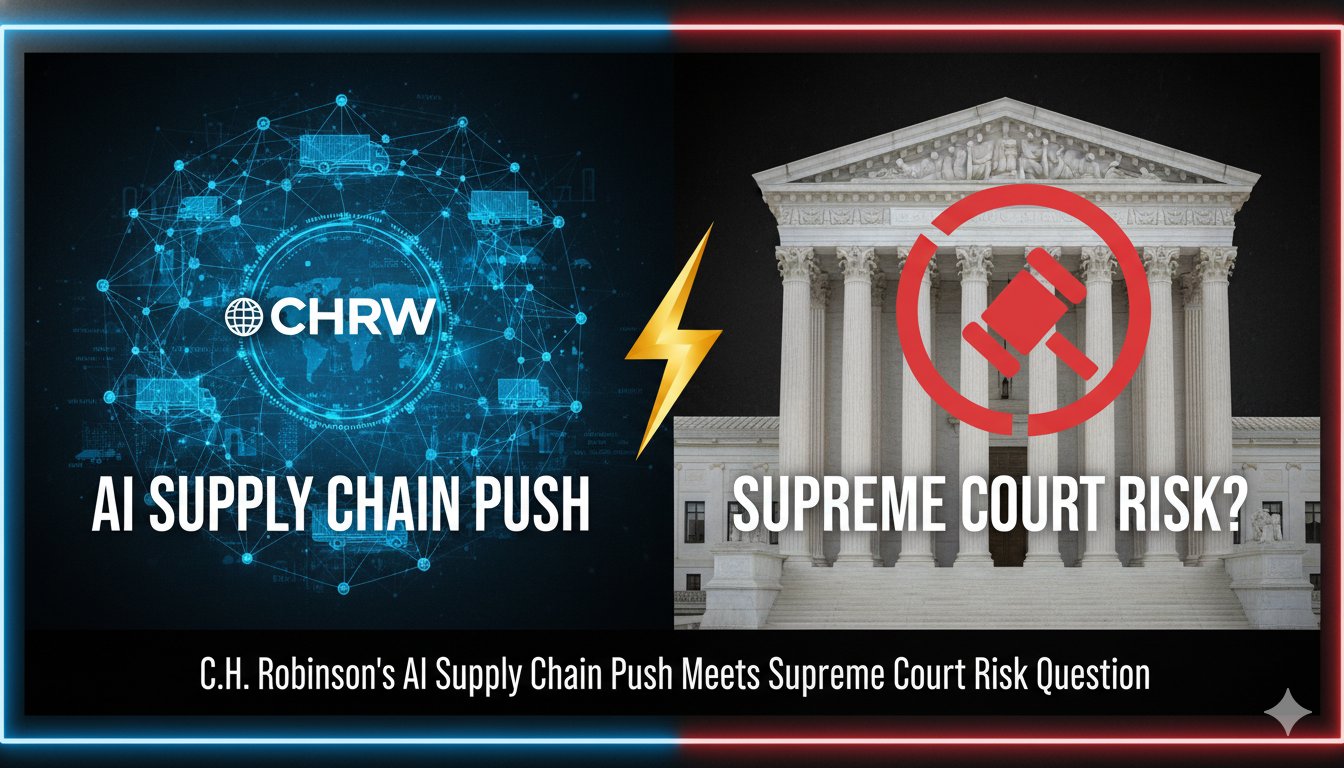
C.H. Robinson is aggressively advancing its Lean AI and Agentic Supply Chain platform, deploying over 30 AI agents to automate millions of logistics tasks, optimize operations, and deliver real-time decision-making for shippers and carriers. This innovation positions the company as a leader in transforming global supply chains through intelligent, adaptive technology. However, a major U.S. Supreme Court case, Montgomery v. Caribe Transport II, LLC, where oral arguments were presented in early March 2026, poses a significant regulatory risk. The case questions whether federal law preempts state-level negligent hiring claims against freight brokers for accidents involving motor carriers, potentially exposing brokers like C.H. Robinson to varying state liabilities that could undermine operational consistency and increase costs in an already tech-driven industry.
C.H. Robinson’s Bold Leap into Agentic AI
C.H. Robinson has positioned itself at the forefront of logistics innovation with the launch of its Agentic Supply Chain solutions. Unveiled in late 2025, this platform represents a shift from traditional automation to a more sophisticated ecosystem where AI agents continuously perceive context, make autonomous decisions, adapt in real time, and self-optimize across global supply chains.
The core of this advancement lies in the Always-On Logistics Planner, a digital workforce comprising more than 30 interconnected AI agents. These agents handle complex, previously manual processes such as quoting, ordering, freight classification, shipment tracking, proof of delivery collection, and resolving issues like missed less-than-truckload (LTL) pickups. In recent deployments, the AI agents have resolved hundreds of shipments daily for thousands of customers, addressing industry-wide pain points that have long defied full automation.
This Lean AI approach combines powerful artificial intelligence with the company’s vast proprietary data from millions of annual shipments and its network of over 450,000 contract carriers. The result is enhanced efficiency: productivity gains exceeding 35% in key areas, reduced manual interventions, and improved cost structures. For shippers, the Agentic Supply Chain promises faster execution, greater resilience against disruptions, and end-to-end intelligence from planning and procurement through to delivery and replenishment.
Executives have emphasized that this is not mere incremental improvement but a redefinition of logistics. The platform allows companies across industries to plug into an intelligent system that learns and acts independently, setting a new standard for AI-driven supply chain management. As one recent initiative highlighted, AI agents are now tackling LTL-specific challenges by tracking missed pickups, analyzing data to improve carrier operations, and ensuring freight keeps moving without delay.
The Looming Supreme Court Challenge
While C.H. Robinson accelerates its AI transformation, a parallel legal battle could reshape the regulatory environment in which these innovations operate. The U.S. Supreme Court heard oral arguments on March 4, 2026, in Montgomery v. Caribe Transport II, LLC , a case originating from a 2019 trucking accident. A driver was injured when a motor carrier vehicle, arranged through C.H. Robinson as the freight broker, veered off the road and collided with another truck.
The plaintiff alleged negligent selection by the broker in hiring the carrier. Lower courts, including the Seventh Circuit, dismissed claims against C.H. Robinson, ruling that the Federal Aviation Administration Authorization Act of 1994 (FAAAA) preempts state tort claims related to broker services. The FAAAA prohibits states from enacting or enforcing laws “related to a price, route, or service” of motor carriers, brokers, or freight forwarders in interstate transportation, with a narrow safety exception tied to motor vehicles.
C.H. Robinson has actively advocated for this interpretation, filing briefs and presenting arguments that emphasize the need for uniform federal regulation. For nearly a century, federal law has governed interstate trucking to ensure consistency, efficiency, and safety across the nation. Allowing state-by-state tort regimes—potentially leading to jury verdicts imposing new duties on brokers—would create a patchwork of rules, increase uncertainty, encourage forum shopping, and disrupt the flow of goods essential to the U.S. economy.
The company argues that brokers, unlike carriers, do not operate vehicles and should not face liability for carrier actions under state negligence standards. This position aligns with the broader industry view that preemption preserves accountability where it belongs—with those directly controlling the vehicles—while supporting reliable, nationwide supply chains.
A ruling against preemption could expose freight brokers to heightened litigation risks under divergent state laws. In an era where AI agents automate carrier selection, vetting, and optimization based on data-driven criteria, such liability could complicate AI deployment, raise insurance costs, and slow innovation adoption.
Interplay Between AI Innovation and Legal Uncertainty
The tension is clear: C.H. Robinson’s AI push relies on scale, data richness, and operational freedom to deliver value. The company’s network handles billions in freight annually, fueling its AI with unmatched insights for better forecasting, inventory management, and transportation optimization.
Yet the Supreme Court case introduces a critical variable. A decision upholding preemption would reinforce the federal framework that enables consistent, tech-enabled operations across states. Conversely, if state claims survive, brokers might face increased scrutiny in carrier selection processes—even when guided by sophisticated AI—potentially leading to more conservative strategies, higher compliance burdens, and fragmented risk management.
Industry observers note that this legal risk comes amid broader market dynamics, including investor concerns over AI disruption in brokerage models. While C.H. Robinson’s leadership views agentic AI as a competitive moat that drives consolidation rather than obsolescence, regulatory clarity remains essential for sustained growth.
Key Operational Metrics and Implications
Annual shipments managed: 37 million
Contract carriers: 450,000+
Customers: 83,000
AI agents deployed: 30+
Tasks automated: Millions per period, including LTL resolutions
Productivity improvement: Over 35% in embedded processes
These figures underscore the scale at which AI operates within C.H. Robinson’s ecosystem. Any escalation in legal exposure could influence how aggressively the company expands its Agentic Supply Chain to new use cases or industries.
The Supreme Court’s impending decision will likely clarify the boundaries of broker responsibility, directly impacting how firms like C.H. Robinson balance cutting-edge technology with enduring regulatory realities in the freight sector.
Disclaimer: This is a news report based on publicly available information and industry developments. It is for informational purposes only and does not constitute legal, investment, or professional advice.