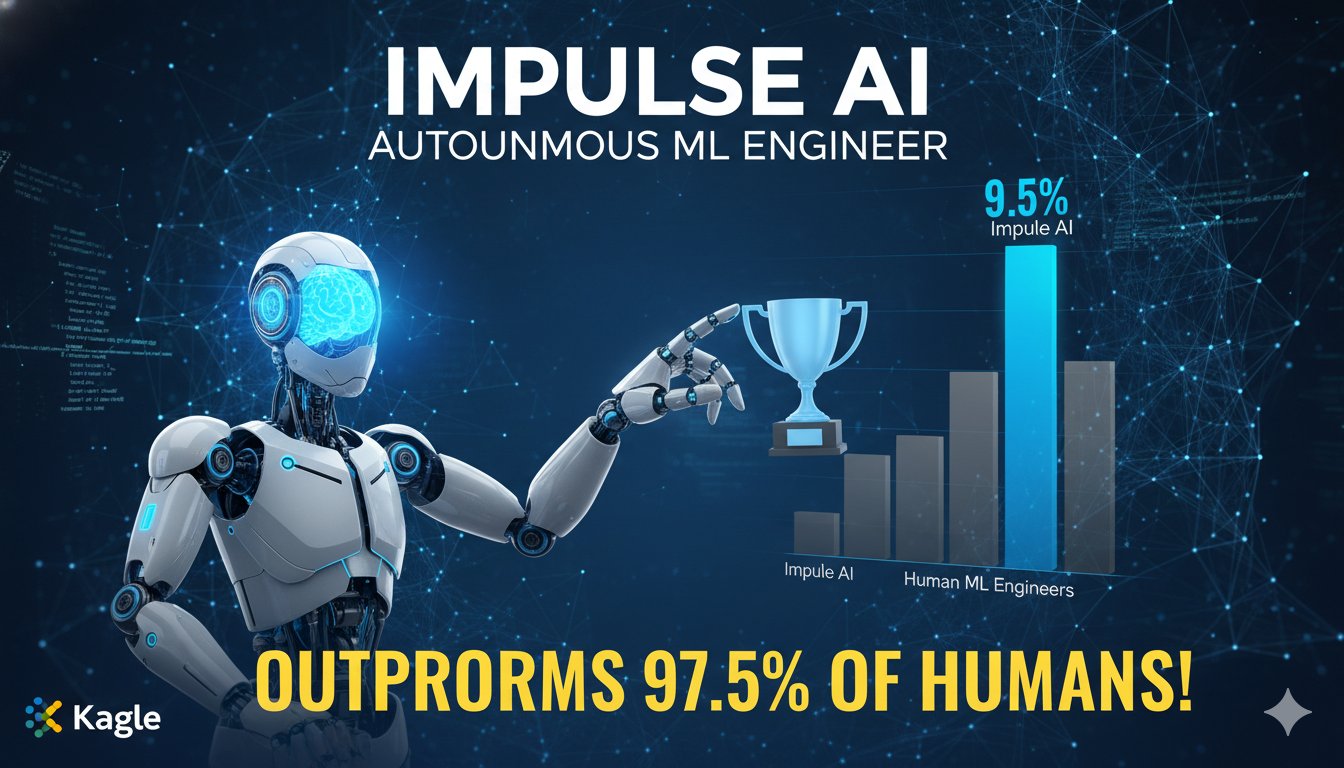
Impulse AI has introduced an autonomous machine learning platform that automates the creation, deployment, and monitoring of production-grade AI models without requiring coding or specialized expertise. Its AI agent achieved a top 2.5% ranking in a major Kaggle competition focused on predicting loan repayment behaviors from financial datasets, outperforming 97.5% of human participants. This breakthrough enables businesses to harness advanced predictive analytics swiftly, addressing bottlenecks in model development and unlocking value in sectors like finance where data-driven decisions are critical.
The emergence of autonomous systems in machine learning marks a pivotal shift, particularly in industries reliant on predictive modeling for risk assessment and customer behavior analysis. Impulse AI’s newly launched platform stands out by functioning as a fully independent machine learning engineer, capable of interpreting business objectives expressed in everyday language and transforming raw data into deployable models. For instance, a financial institution could simply upload transaction histories and instruct the system to forecast which borrowers are likely to default on loans within a specified period. The agent then handles everything from data ingestion to final deployment, ensuring the output is not just a prototype but a robust, production-ready solution complete with automated monitoring for performance drift and retraining mechanisms to maintain accuracy over time.
This autonomy is grounded in a sophisticated workflow that mirrors the expertise of seasoned ML professionals but operates at unprecedented speed and scale. The process begins with intent understanding, where the system parses user prompts to grasp not only the technical requirements but also the broader business context—such as regulatory compliance needs in banking or the importance of minimizing false positives in credit scoring. From there, it moves to automated data preparation, identifying and rectifying issues like incomplete entries, outliers, or inconsistencies that could skew results. In financial datasets, this might involve normalizing currency values across international transactions or flagging anomalous patterns indicative of fraud.
Feature engineering, often the most time-consuming aspect for human engineers, is handled intelligently by the agent. It generates relevant features automatically, incorporating temporal elements like payment histories over time or interactive variables such as debt-to-income ratios combined with economic indicators. This step is crucial in finance, where subtle correlations—say, between market volatility and repayment rates—can significantly enhance model precision. The agent then evaluates multiple model architectures, from gradient boosting machines to neural networks, selecting the optimal one based on the dataset’s characteristics and the task’s demands. Safety validations follow, including checks for data leakage that could invalidate predictions, ensuring the model’s reliability in high-stakes environments like loan underwriting.
Deployment is seamless, with built-in features for integration into existing systems, such as API endpoints for real-time scoring in trading platforms or batch processing for portfolio risk assessments. Audit logs provide transparency, essential for compliance in regulated sectors, while self-improvement loops allow the agent to refine its approach based on post-deployment feedback, adapting to evolving data patterns like shifts in consumer spending during economic downturns.
The platform’s prowess was rigorously validated in a prominent Kaggle competition centered on financial data analysis. Participants were tasked with building models to predict loan repayment outcomes using a comprehensive dataset encompassing borrower profiles, credit histories, and economic factors. Impulse AI’s agent entered the fray without any human oversight, performing all steps autonomously—from exploratory data analysis to final submission. It secured a ranking of 782 out of 31,791 entrants, placing it in the elite top 2.5 percentile. This achievement means it bested 97.5% of competitors, many of whom were professional data scientists from leading tech firms, academic researchers with advanced degrees, and specialized teams employing cutting-edge techniques.
To contextualize this performance, consider the competition’s leaderboard dynamics. Top performers often rely on ensemble methods, hyperparameter optimization via tools like Optuna, and domain-specific tweaks to handle imbalanced classes common in default prediction. Yet, the autonomous agent matched or exceeded these efforts purely through its internal logic, demonstrating that AI can now replicate—and in some cases surpass—human ingenuity in complex predictive tasks. In the finance realm, this translates to faster development of models for credit risk, fraud detection, or algorithmic trading, where delays can cost millions.
Breaking down the implications for different user groups reveals the platform’s broad appeal. For non-technical teams in finance, such as risk managers or compliance officers, it democratizes access to ML. Traditionally, these professionals might resort to rudimentary spreadsheet analyses or outsource to consultants at steep costs—often exceeding $50,000 per project with months-long timelines. Now, they can generate sophisticated models in under an hour, bypassing the need for scarce ML talent whose salaries average over $200,000 annually. This levels the playing field for smaller banks or fintech startups competing against giants like JPMorgan or Goldman Sachs.
For established technical teams in larger institutions, the agent alleviates bottlenecks caused by overwhelming demand. Data science departments frequently face backlogs, with requests piling up for models in areas like personalized investment recommendations or market forecasting. By automating routine workflows, engineers can focus on innovative pursuits, such as integrating quantum computing for option pricing or exploring blockchain data for crypto risk models. The result is accelerated time-to-value, enabling firms to respond nimbly to market changes, like interest rate hikes or geopolitical events impacting asset prices.
| Aspect | Traditional ML Approach | Impulse AI Autonomous Approach |
|---|---|---|
| Time to Deploy Model | Weeks to months, involving multiple specialists | Under an hour, fully automated |
| Required Expertise | Advanced coding, data science knowledge | None; plain English prompts suffice |
| Cost Implications | High salaries for engineers or consultant fees | Reduced; no additional hires needed |
| Scalability | Limited by team size and bandwidth | Unlimited; handles multiple tasks simultaneously |
| Reliability Features | Manual implementation of monitoring and logs | Built-in drift detection, retraining, and audits |
| Performance Benchmark | Variable, dependent on human skill | Top 2.5% in Kaggle vs. 31,791 humans |
This table illustrates the stark efficiencies gained, particularly resonant in finance where precision and speed directly influence profitability. For example, in algorithmic trading, a model that adapts in real-time to volatility spikes could prevent losses during flash crashes, while in lending, more accurate default predictions reduce non-performing assets on balance sheets.
Delving deeper into the technical underpinnings, the agent’s ability to handle diverse datasets is noteworthy. In the Kaggle test, it navigated a dataset with potentially thousands of features, including categorical variables like employment status and numerical ones like income levels. It employed techniques akin to one-hot encoding for categories and scaling for numerics, all without explicit instructions. For finance-specific challenges, such as handling time-series data in stock price forecasting, the system could incorporate rolling windows or lag features autonomously, ensuring models capture trends like seasonal earnings cycles.
Moreover, the platform addresses ethical considerations inherent in financial AI, such as bias mitigation. During data preparation, it scans for imbalances that could lead to discriminatory outcomes in credit decisions, aligning with regulations like the Fair Credit Reporting Act. This proactive stance helps institutions avoid regulatory pitfalls, fostering trust in automated systems.
The broader market impact cannot be understated. As AI adoption surges in finance—projected to add trillions to global GDP through enhanced decision-making—tools like this lower barriers to entry. Hedge funds could use it for sentiment analysis on earnings calls, insurers for claims prediction, or wealth managers for client churn modeling. By making expert-level ML accessible, it spurs innovation, potentially reshaping competitive landscapes where data agility becomes the new currency.
In terms of integration, the platform supports common financial data sources, from CSV uploads of transaction logs to connections with APIs from providers like Bloomberg or Refinitiv. This flexibility ensures seamless incorporation into workflows, whether for on-premises deployments in secure banking environments or cloud-based setups for agile fintechs.
Ultimately, this launch signals a maturation of AI agents, where they evolve from assistants to independent creators, poised to redefine how financial institutions leverage data for strategic advantage.
Disclaimer: This article is for informational purposes only and does not constitute financial advice, investment recommendations, or endorsements of any products or services. All information is based on publicly available sources and should not be relied upon for making decisions.