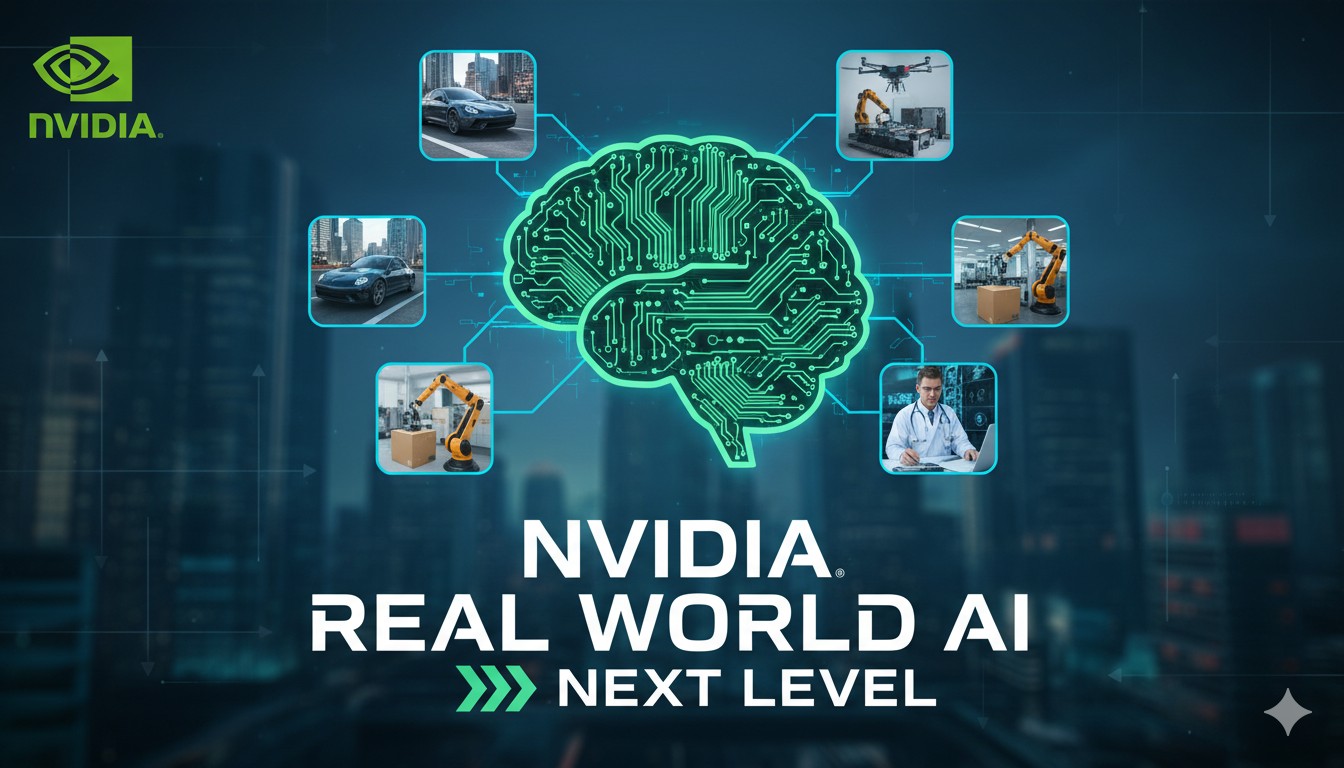
**” Nvidia is accelerating its dominance in physical AI, unveiling advanced open models like Cosmos 3 and Isaac GR00T N1.7 at GTC 2026, enabling robots and autonomous systems to reason, act, and deploy in complex real-world environments. Partnerships with global robotics leaders are scaling production across industries, while new platforms like Vera Rubin power agentic inference, positioning the company at the forefront of embodied intelligence. “**
Nvidia’s Bold Leap into Physical AI
Nvidia continues to redefine the boundaries of artificial intelligence by shifting focus from purely digital applications to embodied systems that interact directly with the physical world. This push into real-world AI, often termed physical AI, encompasses robotics, autonomous vehicles, industrial automation, and beyond. At the heart of this expansion are breakthroughs in foundation models that allow machines to perceive, reason, plan, and execute actions in unstructured environments.
Central to these advancements is the introduction of Cosmos 3, a pioneering world foundation model that integrates synthetic world generation, physical reasoning, and action simulation. This model equips physical AI systems to handle complex, dynamic settings by generating predictive video worlds and enabling generalized intelligence. Developers can now simulate intricate scenarios, transfer knowledge across domains, and post-train models for specific robotic tasks, dramatically reducing the reliance on scarce real-world data.
Complementing this is the latest iteration of Isaac GR00T N1.7, an open reasoning vision-language-action model tailored for humanoid robots. Now commercially viable, GR00T N1.7 supports full-body control, multimodal understanding, and contextual decision-making. It draws on integrated reasoning capabilities to interpret vague instructions, apply common sense, and adapt to novel situations—marking a significant step toward versatile, general-purpose humanoids capable of operating in homes, factories, hospitals, and public spaces.
These models form part of a broader ecosystem built around Nvidia’s Isaac platform, which includes advanced simulation frameworks like Isaac Lab 3.0. Enhanced with the Newton physics engine, Isaac Lab provides physically accurate digital twins for training and validation, ensuring behaviors transfer seamlessly from simulation to reality—a “sim-first” methodology that accelerates development cycles and minimizes risks.
Nvidia has also rolled out the Physical AI Data Factory Blueprint, an open reference architecture that automates the generation, augmentation, and evaluation of massive training datasets. By unifying synthetic data pipelines with tools like OSMO for orchestration, this blueprint slashes costs and complexity for robotics, vision AI agents, and autonomous vehicles. Early adopters, including leaders in industrial and humanoid robotics, are already leveraging it to scale fleets effectively.
Collaborations Driving Real-World Deployment
A key strength lies in Nvidia’s extensive partnerships with robotics giants and innovators. Companies such as ABB Robotics, FANUC, KUKA, YASKAWA, Figure, Agility, and others are integrating Nvidia technologies into production systems. These collaborations span industrial arms for manufacturing precision, surgical robots for healthcare precision, and humanoid platforms for versatile tasks.
For instance, industrial leaders are deploying Nvidia-accelerated systems in factories to enable adaptive automation, where robots handle variable workflows with human-like dexterity. In healthcare, integrations support real-time guidance for procedures, enhancing outcomes through AI-assisted tools. Humanoid developers benefit from GR00T’s capabilities to create machines that collaborate safely alongside people.
The ecosystem extends to autonomous vehicles, where models like Alpamayo provide open portfolios for perception, simulation, and policy training, supporting safer, more intelligent self-driving technologies.
Infrastructure Powering the Transition
To support the computational demands of physical AI, Nvidia unveiled the Vera Rubin platform, featuring seven new chips in full production. This architecture optimizes every phase of AI—from pretraining to agentic inference—delivering substantial efficiency gains. Systems like the Vera Rubin NVL72 rack achieve up to 10x higher inference throughput per watt compared to prior generations, making real-time processing feasible at scale.
Edge computing receives a boost through Jetson modules, enabling on-device inference for robots and vehicles. Combined with cloud-to-edge orchestration via OSMO, developers can manage workflows across distributed environments seamlessly.
Market Impact and Momentum
Nvidia’s strategic emphasis on physical AI aligns with surging demand for embodied intelligence. The company’s aggressive pivot toward inference computing underscores the shift from training large models to deploying them in real-time applications. Projections indicate a trillion-dollar opportunity in AI chips through the coming years, driven by this expansion.
As of mid-March 2026, Nvidia’s market capitalization hovers around $4.45 trillion, reflecting investor confidence in its leadership across accelerated computing and emerging physical AI domains. Shares have shown resilience amid broader market dynamics, trading in the low $180s recently.
Key Advancements in Nvidia’s Physical AI Push
Cosmos 3 : Unifies world generation, reasoning, and simulation for generalized physical intelligence.
Isaac GR00T N1.7 : Commercially ready VLA model for humanoids, supporting full-body actions and advanced reasoning.
Physical AI Data Factory Blueprint : Automates data pipelines to cut training costs and time significantly.
Vera Rubin Platform : New chips and racks optimized for agentic AI inference at massive scale.
Ecosystem Scale : Integrations across millions of robots in industrial, healthcare, and humanoid applications.
These developments signal Nvidia’s transition from powering digital AI to enabling machines that inhabit and transform the physical world, setting the stage for widespread adoption in everyday and enterprise settings.
Disclaimer: This is for informational purposes only and does not constitute investment, financial, or legal advice.