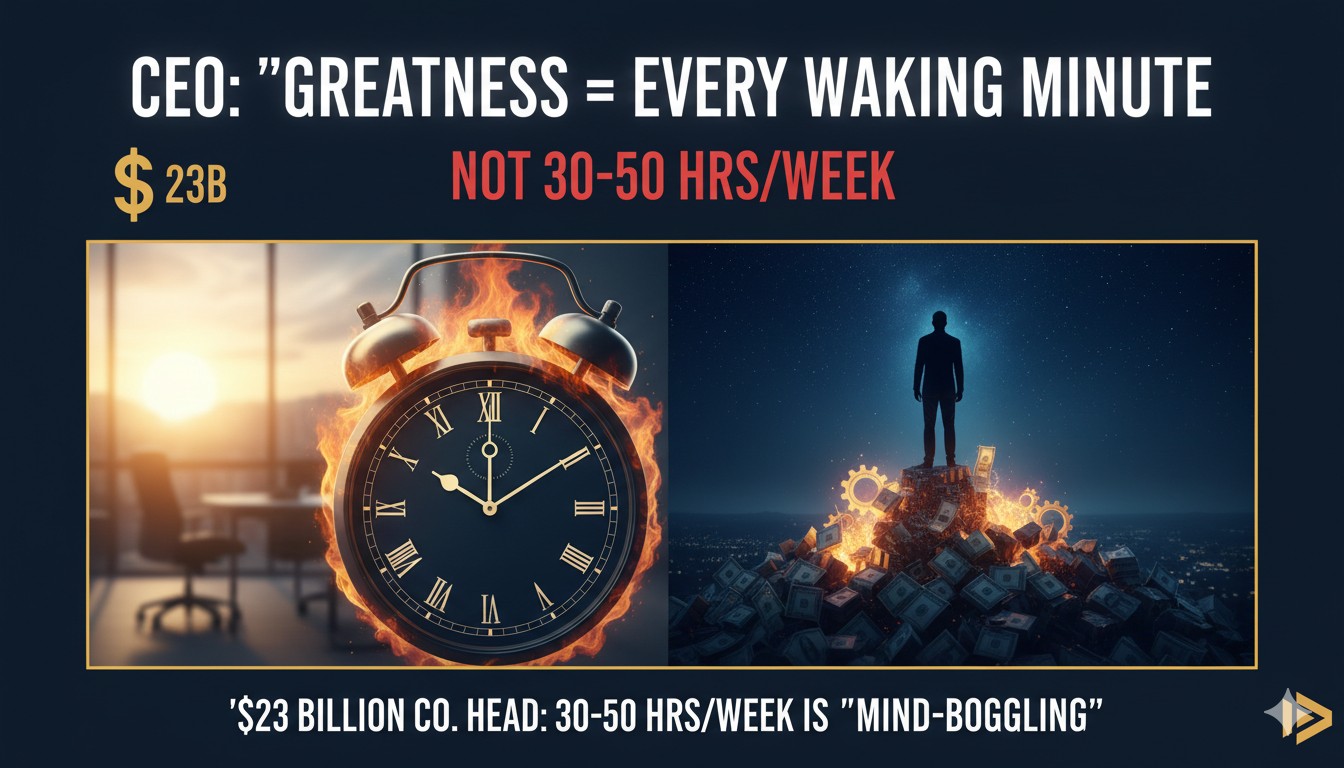
“This notion that you can achieve greatness or build something truly extraordinary while sticking to a standard 38-hour workweek and maintaining perfect work-life balance is mind-boggling. The path to creating something new out of nothing and making it exceptional isn’t part-time—it’s not 30, 40, or 50 hours a week. It’s every waking minute, and yes, there are real costs to that level of commitment.”
Cerebras CEO Andrew Feldman’s Bold Stance on Work Ethic in the AI Era
Andrew Feldman, co-founder and CEO of Cerebras Systems, the AI hardware innovator now valued at approximately $23 billion following its latest funding rounds, recently sparked widespread discussion with his unfiltered take on what it truly takes to build a groundbreaking company in one of the most competitive tech landscapes.
Speaking candidly, Feldman emphasized that disrupting a dominant player like Nvidia—which has achieved a multi-trillion-dollar market position in AI accelerators—demands far more than a conventional schedule. He described the pursuit of such ambition as requiring total immersion, where the mission consumes every available moment of consciousness. This perspective aligns with the high-stakes reality of scaling an AI chip company that designs massive wafer-scale processors designed to handle the immense computational demands of large language models and generative AI training.
Cerebras has positioned itself as a direct challenger in the AI infrastructure space. Its flagship CS-3 system and upcoming generations aim to deliver orders-of-magnitude improvements in speed and efficiency for AI workloads compared to traditional GPU clusters. The company’s approach involves building the largest single chips ever produced, enabling faster processing with lower energy consumption per token in inference and training tasks. This technical edge has attracted significant investor interest, culminating in valuations that have climbed rapidly amid the broader AI boom.
Feldman’s comments highlight a recurring theme among founders tackling moonshot-level problems in technology. In sectors like AI semiconductors, where development cycles are long, capital requirements are enormous, and competition is fierce, partial dedication often falls short. He likened the process to elite-level pursuits in other fields—such as professional athletics or high-performance research—where extraordinary outcomes stem from relentless focus rather than measured routines.
Key Elements of Feldman’s Philosophy on Building Greatness
Total Devotion Over Structured Hours : Feldman argued that true innovation rarely emerges from balanced, predictable schedules. Instead, it requires a mindset where the work becomes an all-encompassing priority, extending beyond office hours into personal time.
Acknowledgment of Trade-Offs : He openly noted the personal costs involved, including sacrifices in family time, hobbies, and rest. This honesty underscores that such intensity isn’t presented as universally desirable but as a necessary trade-off for those aiming to create category-defining companies.
Team Alignment is Critical : Success at this level isn’t solitary. Feldman stressed the need for a team equally passionate and committed, where members share the same level of devotion to the mission. Hiring and retaining talent that thrives in this environment becomes a core leadership challenge.
Context in the AI Arms Race : The remarks come at a time when the AI sector is seeing explosive growth. Cerebras is racing to capture market share in a field dominated by established giants, with massive funding rounds reflecting investor belief in its potential to reshape data center computing for AI.
Critics of this approach often point to evidence that sustained overwork can lead to diminished returns, higher turnover, and health issues. Studies in organizational psychology suggest that productivity plateaus or declines after certain thresholds, and many successful companies have adopted hybrid models emphasizing sustainable performance. Yet Feldman’s view resonates with a segment of Silicon Valley founders who see intense periods of focus as essential for breakthroughs, particularly in hardware innovation where engineering challenges are profound and timelines unforgiving.
Broader Implications for Entrepreneurs and Professionals
Feldman’s statement serves as a reality check for aspiring builders in high-growth industries. While a stable 40-hour week can support a rewarding career in many roles, launching and scaling a transformative enterprise often demands periods of extreme effort. This is especially true in capital-intensive fields like semiconductors, where first-mover advantages and technical superiority can determine long-term dominance.
For investors, such candor from leadership can signal confidence in the company’s trajectory and the founder’s willingness to do whatever it takes. Cerebras continues to secure substantial capital, reflecting belief that its architecture could play a pivotal role in the next phase of AI deployment.
The debate Feldman reignited touches on fundamental questions about ambition, sacrifice, and success in modern capitalism. In an era of rapid technological change, his message is clear: greatness in disruptive innovation rarely comes from moderation—it emerges from unwavering, all-in commitment.
Disclaimer: This is a news report based on public statements and market developments. It is for informational purposes only and does not constitute financial, career, or personal advice.